
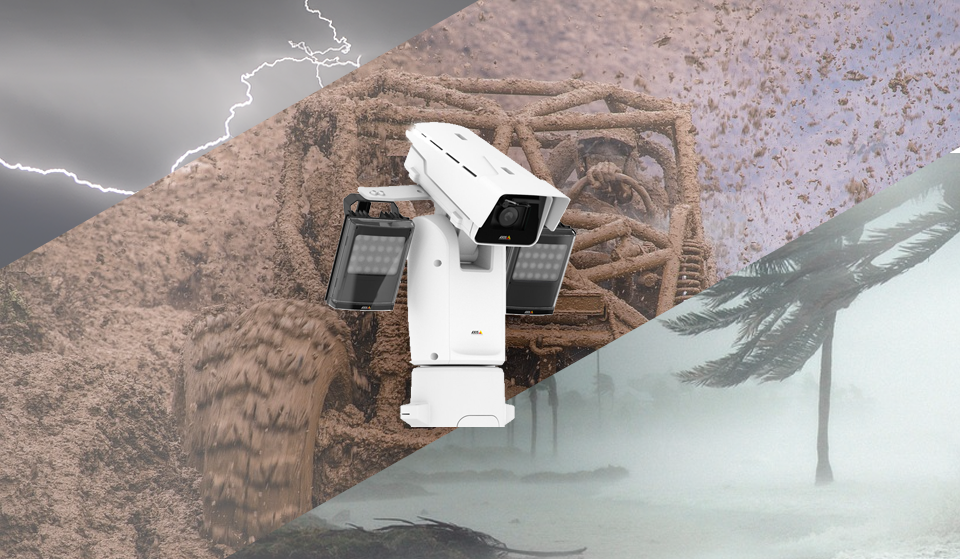
It has been proven that conducting preventive projects aimed at improving workplace safety and disaster prevention is important in any type of industry. However, to effectively mitigate the risks of catastrophes or accidents in the workplace, it is necessary for the professional to design the project specifying all possible risks and, based on these, seek the correct equipment.
In the CCTV market, this type of care needs to be amplified, as in most cases, these devices must be available and fully operational for both surveillance and data collection, as well as to assist in dynamic decision-making.
To this end, we will highlight in this article some characteristics that may be fundamental for a consistent CCTV project that can withstand and deliver data even in adverse events such as landslides, storms, etc.
Resistance
The first thing to be defined in a project involving complex engineering is the quality of the equipment and its resistance to water, dust, strong impacts, etc. When searching for an IP camera on Google, one can find various models at different prices; however, a large part of the models may be intended for residential or small commercial use. Therefore, it is the responsibility of the project professional to identify the equipment that can truly withstand the adversities of the location where it will be installed.
A good tip for finding a quality camera is to look for the main resistance certifications such as IP, NEMA, and IK.
As we mentioned in our article about camera specifications, the IP certification is responsible for demonstrating the equipment's resistance to dust and water and can be found mainly in cameras for outdoor use.
The certification acronym is accompanied by two numbers; the first number can be cataloged from 0 to 6 and is responsible for showing the level of dust resistance, with 0 representing the lowest level and 6 the highest.
The second number represented in the acronym shows the level of water resistance and is cataloged from 0 to 8, demonstrating the levels of resistance in increasing order according to the previous number.
IP66 and IP67 are the most common combinations found in quality CCTV cameras.
The NEMA classification, established and standardized by the National Electrical Manufacturers Association, is a set of technical standards established for the protection of equipment. One of the differences between this classification and the IP classification is that the former is primarily used in equipment in the United States, while the latter is common for the rest of the world.
An example of a NEMA classification used in equipment resistant to water jets, dust, and ice corrosion is NEMA4X.
In addition to the classifications above, we can also identify the IK09 and IK10 classifications, which are regulated by the international standard IEC 62262 and are used to define the level of resistance of the equipment against impacts. The higher the number accompanying the acronym, the greater the level of resistance testing that the equipment has been evaluated and approved for.
Zoom and Identification
The location of CCTV equipment is also a point of extreme importance in a preventive project. For this, the CCTV technician needs to identify the locations where monitoring will be conducted and, based on these, design the “Key” locations so that the equipment can identify images within an area that can provide the highest possible security without loss of quality.
In other words, the more a device has characteristics of Zoom, Resolution, and Wide Field of View, the easier it will be to identify a surveillance location with a safe distance for the equipment to be installed.
Below, we highlight some cameras from the professional brand Axis that not only have high levels in the IP, NEMA, and IK classifications but also have Lens, Zoom, and Resolution specifications ideal for installation in strategic locations, especially in dams, hydroelectric plants, and mining companies.

Q8685-E
Q8685-LE

Q6125-lE

Q6155-E
Additional Features
There are other auxiliary features that may be important depending on the location and purpose of the project, such as infrared image capture and Speed Dry.
Infrared
Cameras that include infrared in their specifications are considered day and night cameras. It is common to use infrared LED with intelligent light detection, where usually during the day the camera uses its standard setting to detect color images, and at night the infrared module comes into use for image capture.
SpeedDry
The Speed Dry functionality is one of the standout features in Axis's Sharpdome cameras. This technology includes a mechanism that, when activated, causes the camera to vibrate at high speeds, breaking up water droplet particles, thus keeping the field of view clear even in rainy weather or storms.
There are various technical specifications and consequently various types of CCTV camera models that can meet the requirements of large industries; however, it is always advisable to seek a qualified professional to ensure that the project is carried out as safely as possible.


